Operator runbook
Day-to-day operations for an edssa-server-ce deployment.
Deployment topologies
Sidecar (recommended)
┌──────────── Pod / VM ─────────────┐
│  edssa-server-ce :8080  ──▶ app   │
│                                   │
└─── Ingress :80 / :443 ────────────┘
edssa-server-ce listens on :8080; your app listens on
something the sidecar reaches over loopback. An external load
balancer terminates TLS and forwards :443 → :8080.
This is the
samples/nginx-quickstart
samples/k8s-helmpattern. CE supports nothing else by design — multi-tenant gateway patterns are Enterprise.
Behind a TLS edge
edssa-server-ce speaks plain HTTP. Put Caddy / nginx / a managed
load balancer in front for TLS:
client ──TLS──▶ Caddy ──HTTP──▶ edssa-server-ce ──HTTP──▶ app
The CE binary does not verify TLS itself — it relies on the trust boundary at the TLS-terminating proxy. If you need mTLS or a cryptographic edge channel, layer it at the edge.
Seed provisioning
Phase 8 ships the same seed-provisioning bridge as Phase 1
(ADR-003): the operator generates seeds locally, encrypts at rest
with age, and copies to the box. Phase 6 (Enterprise-only) adds
ML-KEM onboarding (F-07) and makes seeds ephemeral.
# 1. Generate
LC_ALL=C tr -dc 'A-Za-z0-9' < /dev/urandom \
  | head -c 1024 > seeds/fleet-demo.seed

# 2. Encrypt at rest against the box's age recipient
age -R seeds/box.age-pub \
    -o seeds/fleet-demo.seed.age seeds/fleet-demo.seed

# 3. scp to the box
scp seeds/fleet-demo.seed.age ops@box:/opt/edssa/secrets/

# 4. Operator decrypts at container start; plaintext stays on tmpfs
For the CE Helm chart, the seed lives in a Kubernetes Secret the
chart references by name (not value) — operators provision it
out-of-band so it never appears in helm get values.
Rotating the seed
CE first cut does not run a ratchet — ActiveEdssaState is
derived from the seed at boot and never advances. Rotating the
seed therefore means rotating clients in lockstep:
- Stop accepting new sessions (out-of-band signal, e.g. set a feature flag in your app).
- Provision the new seed everywhere.
- Restart
edssa-server-ce. - Restart clients with the new seed.
Enterprise’s ratchet driver lets you publish new state under a running verifier without disrupting in-flight requests. CE sidesteps the complexity at the cost of a brief restart window.
Observability
CE intentionally ships minimal observability — no Prometheus endpoint, no transparency log, no F-20 ring buffer. What you get:
- Tracing logs to stdout in JSON. Filter via
RUST_LOG. Audit emissions follow the tier:silent→ no per-request emission.errors→info-level emission on every reject.result→info-level emission on every accept AND reject.
/healthzfor liveness / readiness.
If you need metrics + traces + Tier-4 Merkle audit, run the Enterprise binary.
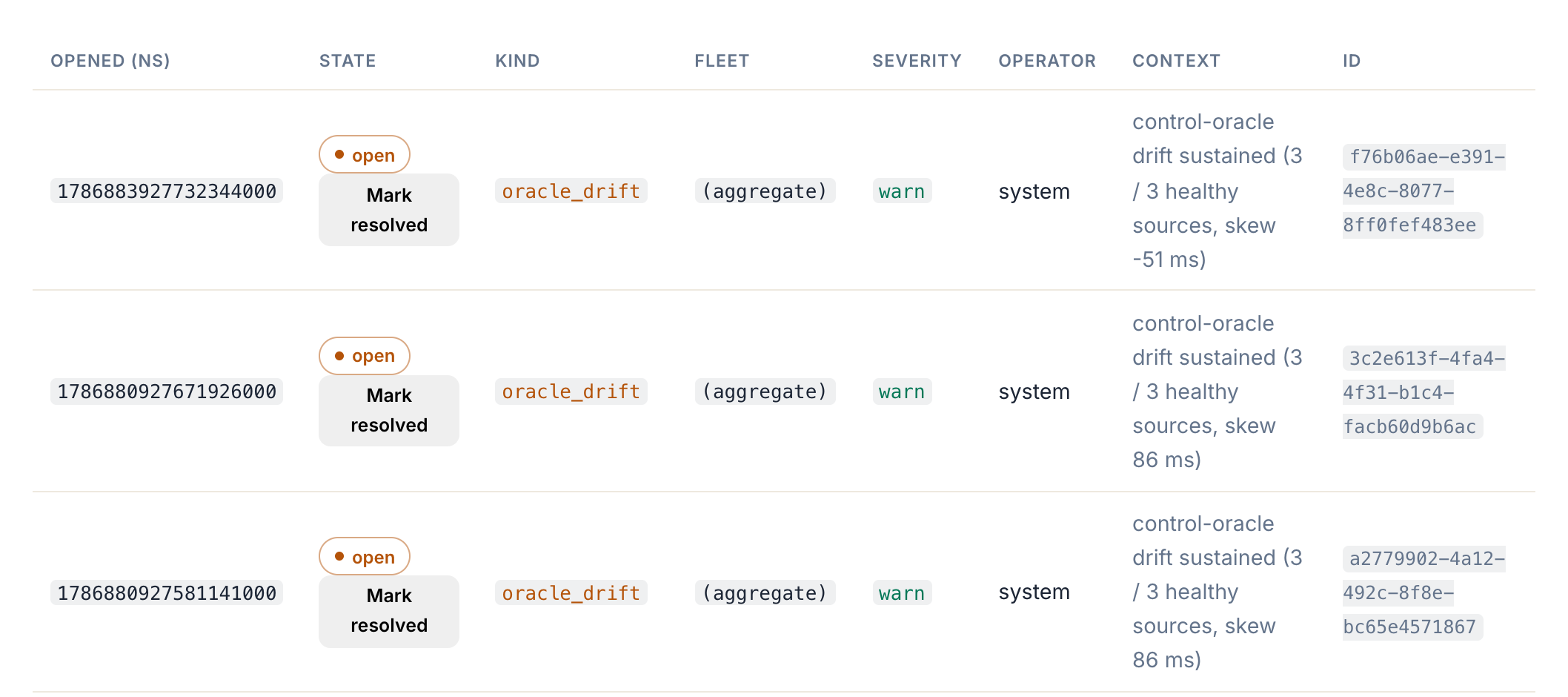
operator: system), and the context string carries the measurement that tripped it — here a sustained control-oracle skew while all three sources were still healthy, which is the case a liveness check alone would never report. Each stays open until an operator resolves it, so the record survives the condition clearing.Common operations
“How do I add a fleet?”
You don’t. CE is one fleet per process. Spin up another CE binary for the second fleet, or upgrade to the Enterprise build for multi-fleet routing.
“How do I tighten the security posture?”
Switch the manifest preset:
preset = "high-security"→T = 44(no margin; every secret byte must match).- Drop
sub_id_rangeto a tight band, e.g.[1, 8], so a compromised sub-ID claim from one client can’t pose as another.
Per-byte tightening:
- Set
chaff_Chigher → smallerR_effbut smaller observable attack surface. - Set
threshold_Tclose toR_eff→ less resilience, more bits of effective secrecy.
“How do I temporarily disable enforcement?”
Don’t. If you need a bypass, put a feature flag in your app and route the bypassed traffic to the upstream directly — never wave the sidecar through.
“What happens if the seed file disappears?”
edssa-server-ce fails to start with seed_path does not exist.
The previous binary keeps running; the next restart fails. Tie the
restart loop into your platform’s “stop accepting new connections”
behaviour so a missing seed = service degraded, not service down.
Patent advisory
EdSSA is patent-pending. The Community Edition ships under BSL 1.1 with an explicit non-revocable patent grant for permitted use (non-commercial OR commercial ≤ $1M ARR). See Patent advisory.